Wednesday, June 1, 2016

Hotel de Ville


The Hôtel de Ville de Paris has been the seat of the Paris City Council since 1357. The current building, with a neo-renaissance style, was built by architects Théodore Ballu and Edouard Deperthes on the site of the former Hôtel de Ville which burnt down during the Paris Commune in 1871. Visits to the town hall, a powerful and prestigious place, are possible. Guided tours are offered by reservation only and are organized by the city’s Protocol Department. Visitors can discover the function room, created as a replica of the Hall of Mirrors at Versailles. Free major exhibitions are also organized here and are a great success.


What you may SEE:
1. giant wire ball- géant boule de fil
2. lots of water- beaucoup de l'eau
3. towers- les tours
4. white statues on roof- statues blanches sur le toit
5. ice skating rink- patinoire

What you might HEAR:
tour guides talking- guides touristiques parlant

FOOD: du pot-au-feu

DESSERT: madeleines


Qu'est-ce qe tu as fait?? ( what did you do?)
A l'hotel de ville, je suis allé le patinage sur glace en hiver (I went ice-skating in the winter)

Friday, May 6, 2016

Montmartre


Montmartre has captivated Bohemian artists since the Belle Epoque and continues to delight tourists today. Perched on a hilltop, Montmartre is a world apart from the rest of Paris despite being the 18th arrondissement (Abbesses Métro station). Montmartre has a unique ambience. Joie de vivre is everywhere - at merry-go-rounds, quaint sidewalk cafés, and impromptu street performances. Tourists flock to the stunning Sacré-Coeur Basilica on the highest point of Mont Martyr where the martyr Saint Denis was buried. 


What you may SEE:
1. stairs- escaliers
2. amazing view- cue imprenable
3. cobblestone streets- rues pavees
4. caricature drawings- dessins de caricature

What you may HEAR:
people walking down cobblestone streets- les gens marcher dans les rues pavées
FOOD: Confit de canard
DESSERT: saint honoré

Qu'est-ce qe tu as fait?? ( what did you do?)
A la Montmarte, j'ai marche dans les rues pavees

Saint Germain des Pres


If you had to choose the most classically Parisian neighborhood, this would be it. St-Germain-des-Prés has it all: genteel blocks lined with upscale art galleries, storied cafés, designer boutiques, atmospheric restaurants, and a fine selection of museums. Cast your eyes upward after dark and you may spy a frescoed ceiling in a tony apartment. These historic streets can get quite crowded, especially in summer, so mind your elbows and plunge in. This quartier is named for the oldest church in Paris, St-Germain-des-Prés, and it's become a prized address for Parisians and expats alike.

What you may SEE:
1. Cafe de Flore
2. tall tower- haute tour
3. triangular gray roof- toit gris triangular
4. crosswalks- passage cloute
5. hotels- les hotels

What you may HEAR:
cars- des voitures

FOOD: le vol-au-vent

DESSERT: profiteroles


Qu'est-ce qe tu as fait?? ( what did you do?)
A le Saint Germain des Pres, j'ai fait les courses (I shopped)

The Latin Quarter

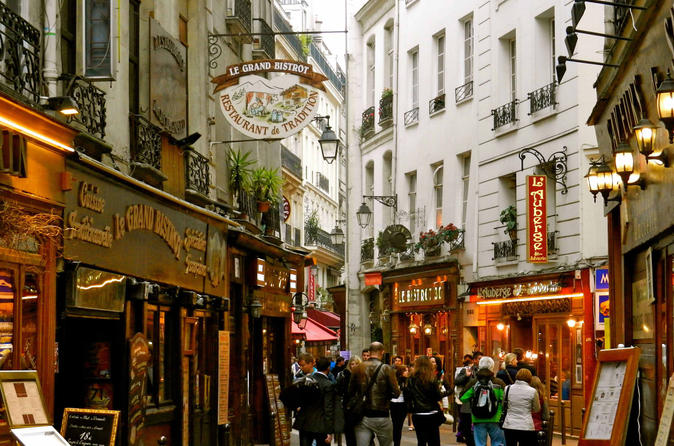
Quartier Latin’s winding streets and warmly lit cafes inspire plein-air impressionism and late-night revelry. Revered for its bohemian beginnings, the neighborhood is frequented by students, thinkers, and travelers in the mood for ethnic eateries, challenging discourse, and cool nightlife. Second hand bookstores and first-rate dive bars snuggle together, often serving as platforms for feverish academic dialogues. Quartier Latin’s unassumingly hip demeanor permeates its surroundings, but the regality of Notre Dame is just a neighborhood away.


What you may SEE:
1. shops- les magasins
2. cafes- les cafes
3. restaurants- les restaurants
4. bikes- les velos
5. sings- les signes

What you may HEAR:
people eating and shopping- les personnes mangent et de shopping

FOOD: la soupe aux oignons

DESSERT: Canelés


Qu'est-ce qe tu as fait?? ( what did you do?)

A le Quarter Latin, j'ai mange dans un cafe

Wednesday, April 27, 2016

Les Catacombs


Paris, the capital of France, is often called La Ville Lumière (meaning ‘The City of Light’), however, beneath this bustling European city of 12 million people, lies a dark subterranean world holding the remains of 6 million of its former inhabitants. These are the Paris Catacombs: a network of old caves, quarries and tunnels stretching hundreds of miles, and seemingly lined with the bones of the dead.


What you may SEE:
1. skulls- cranes
2. bones- des os
3. long corridors- longs couloirs
4. crosses- des croix
5. tunnels- les tunnels

What you may HEAR:
ghosts- des fantômes
FOOD: la salade lyonnaise

DESSERT: Choux à la crème


Qu'est-ce qe tu as fait?? ( what did you do?)

A les Catacombs, j'ai marche beaucoup (I walked a lot)

Place de la Concorde


Place de la Concorde is situated at the end of the Champs-Elysées. Today it is famous for the Luxor Obelisk (a 3,300 year old Egyptian obelisk erected on the square in May 1998), the surrounding prestigious hotels, and the two monumental fountains (Fontaine des Mers and Fontaine des Fleuves). Created in 1772, Place de la Concorde was originally known for having been an execution site during the French Revolution. Louis XVI and Marie-Antoinette (among others) were guillotined here. Between 1836 and 1846 the architect Jacques-Ignace Hittorf redesigned the square to become what it is today.

What you SEE:
1. big fountain- grande fontaine
2. obelisk- obelisque
3. horse statue- cheval statue
4. streets-des rues
5. tall light poles- lampadaires de hauteur

What you HEAR:
the fountain splashing- le clapotis de la fountaine

FOOD: une quiche

DESSERT: gateau basque


Qu'est-ce qe tu as fait?? ( what did you do?)
A le Place de la Concorde, j'ai vu la fontaine

Disneyland Paris


Disneyland Paris, originally Euro Disney Resort, is an entertainment resort in Marne-la-Vallée, a new town located 32 km east of the centre of Paris, and is the most visited theme park in all of France and Europe. 
Even big kids can have great fun and thrills in a day at Disneyland. With 2 Disney parks®, more than 50 attractions, shows and parades, Disneyland Paris promises a unique day with friends or family. With 5 themed worlds, the Parc Disneyland® is a dream place for big kids on the lookout for magic and lots of fun! Feel the adrenaline exploring the far reaches of space or the remains of an abandoned temple. Next door, the Walt Disney Studios Park® offers many adventures and thrills: defy gravity in a plummeting elevator, live a 100% Rock 'n' Roll adventure with bends and looping or enjoy Remy's mad adventure! But save some energy to enjoy the fantastic shows and parades late into the night.
Just a day at Disneyland Paris for a lifetime of memories is a lot closer than you ever thought possible.


What you may SEE:
1. mickey mouse- Mickey la souris
2. pink castle- chateau rose
3. rides- maneges
4. kids- enfants
5. characters- personnages

What you may HEAR:
people laughing and screaming- les personnes rire et crier

FOOD: le pan-bagnat

DESSERT: les macarons


Qu'est-ce qe tu as fait?? ( what did you do?)
A le Disneyland de Paris, j'ai recountre Minnie Mouse (I met minnie mouse)

Pont Alexandre III


Inaugurated on the occasion of the 1900 Universal Exhibition and classed as a historic monument, the Pont Alexandre III is one of the most emblematic bridges in Paris because of its architecture and location. At its four extremities are huge 17 metre-high pylons crowned with gilt bronze sculptures of winged horses representing the illustrious Arts, Sciences, Commerce and Industry. Pont Alexandre III connects the Invalides on the Left Bank to the Grand Palais and Petit Palais on the Right Bank. From the bridge you can enjoy a sweeping view of these buildings as well as the Eiffel Tower and over the Seine, which makes it a popular place for a stroll at any time of day or night.


What you may SEE:
1. golden winged statue- statue ailee d'or
2. lamp posts-lampadaires
3. hanging wreath statues- pendaison statues de couronnes
4. Le Siene
5. boats- les bateaux

What you might HEAR:
boats- les bateaux

FOOD: une omelette aux fines herbes

DESSERT: noissette (hazelnut) dacquiose


Qu'est-ce qe tu as fait?? ( what did you do?)
A le Pont Alexandre 111, Je suis allé sur une promenade en bateau (I went on a boat ride)

Tuileries Garden


The Tuileries Gardens get their name from the tile factories which previously stood on the site where Queen Catherine de Medici built the Palais des Tuileries in 1564. The famous gardener of King Louis XIV, André Le Nôtre, re-landscaped the gardens in 1664 to give them their current French formal garden style. The gardens, which separate the Louvre from the Place de la Concorde, are a cultural walking place for Parisians and tourists where Maillol statues stand alongside those of Rodin or Giacometti. The gardens’ two ponds are perfect for relaxation. The Musée de l’Orangerie, where visitors can admire the works of Monet, is located south-west of Tuileries. From March to December, free tours in French are organized. For lovers of candyfloss, rides and thrills, go to the Fête des Tuileries from June to August.


What you may SEE:
1. ferris wheel- grande roue
2. tulips- les tulipes
3. round ponds- bassins circulars
4. big white statue- grande statue blanche
5. Eiffel tower- le tour d'Eiffel

What you might HEAR:
people riding the ferris wheel- personnes surfant sur la grande roue

FOOD: les moules marinières
DESSERT: choux à la crème (cream puffs)


Qu'est-ce qe tu as fait?? ( what did you do?)
A le Tuileries Garden, j'ai vu le grande roue 

Les Invalides

The Hôtel des Ivalides was commissioned in 1670 by Louis XIV in order to provide accommodation and hospital care for wounded soldiers. In 1815, after Napoleon's abdication, over 5,000 survivors of the Great Army were listed there. Napoleon inspected the place and visited his men in 1808, 1813 and 1815.

The chapel of the Invalides was built at the end of the 17th century by Jules-Hardouin Mansart and contains Napoleon's tomb. In 1840, during the 'Return of the Ashes', a law passed on 10th June ordered the construction of the Emperor's tomb below the dome of the Invalides.


What you may SEE:
1. Napolean's tomb- La tombe de napolean
2. long walkway- longue promenade
3. cloudy sky- ciel nuageux
4. gold top- top d'or
5. big dome- grande coupole

What you may HEAR:
people talking about all the amazing things- les gens parler de toutes les choses étonnantes
FOOD: steak frites

DESSERT: de pain au chocolate/crossaint au chocolate


Qu'est-ce qe tu as fait?? ( what did you do?)
A Les Invalides, j'ai vu la tombe de Napolean

Palais Garnier

A 19th-century architectural masterpiece, the Palais Garnier Opera House, built by Charles Garnier and opened in 1875, is the 13th opera house in Paris since the introduction of French opera by Louis XIV in 1669. Napoleon III commissioned it as part of the renovation works in the capital carried out under his command by Baron Haussmann. A historical monument open to visitors during the day staging opera and dance. Don't forget to admire the ceiling painted by Chagall in the main auditorium.


What you may SEE:
1. gold angles- anges d'or
2. plush red seats- sieges rouges en pelota
3. long staircases- longs escaliers
4. big circular mural- grande fresco circular
5. bright chandeliers- lustrous brillants

What you may HEAR:
opera singing- chant lyrique

FOOD: le gratin dauphinois

DESSERT: meringue


Qu'est-ce qe tu as fait?? ( what did you do?)
A la Palais Garnier, j'ai ecoute l'opera

Sainte-Chapelle


The Sainte-Chapelle ("Holy Chapel"), located within the Palais de Justice complex on the Ile de la Cité in the center of Paris, is a diminutive yet perfect example of the Rayonnant Style of Gothic architecture. It was erected by Louis IX, king of France, to house the Crown of Thorns and a fragment of the True Cross, precious relics of the Passion. Louis had purchased these in 1239 from the Byzantine emperor Baldwin II, for the exorbitant sum of 135,000 livres (the chapel "only" cost 40,000 livres to build). Two years later, more relics were brought from Byzantium.


What you may SEE:
1. fantastic stained glass- fantastique vitrail
2. beautiful, tall ceilings- beaux, hauts plafonds
3. big stained glass windows-grands virtual
4. church alter- egalise modifier
5. big open space- grande space ouvert

What you may HEAR:
choir singing- chant coral

FOOD: un croque-monsieur

DESSERT: palmiers


Qu'est-ce qe tu as fait?? ( what did you do?)
A le Sainte-Chapelle, j'ai vu toute le vitrail

Versailles Palace

The Palace of Versailles is the central part of a complex that housed the French government, most notably its royalty, during the reigns of Louis XIV (France’s famed “Sun King”), Louis XV and Louis XVI. After the French Revolution in 1789, it ceased to be a permanent royal residence.
Located about 10 miles (16 kilometers) southwest of Paris, it is beside the settlement of Versailles. Before the construction of the palace by Louis XIV, this settlement was little more than a hamlet but by the time of the revolution it had a population of more than 60,000 people, making it one of the largest urban centers in France.
Before the revolution, the Versailles complex included the palace, gardens, a walled-in royal hunting ground, a smaller palatial structure known as the Grand (or Marble) Trianon and an estate used by Marie Antoinette, Louis XVI’s queen. Between the palace and the town there are also buildings that housed the war and foreign affairs ministries, residences for those not entitled to live in the palace, stables and a kennel, among other structures.


What you may SEE:
1. gardens with designs- jardins avec des dessins
2. poseidon statue- poseidon statue
3. large pond- grand etang
4. long walls- longs murs
5. lots of windows- beaucoup de fenetres

What you may HEAR:
people throwing things in the big pond- gens jeter des choses dans le grand étang
FOOD: un croque-madame

DESSERT: tulipes


Qu'est-ce qe tu as fait?? ( what did you do?)
A le Versailles Palace, j'ai jeté des pièces de monnaie dans l'eau (I threw coins in the water)

Musee d’Orsay


The Musée d'Orsay is a museum housed in a grand railway station built in 1900. Home to many sculptures and impressionist paintings, it has become one of Paris's most popular museums.At the turn of the nineteenth century, two large railway stations were built in Paris, the Gare de Lyon and the Gare d'Orsay. The Gare d'Orsay had the most prominent site, along the Seine opposite the Louvre. The railway station was planned by the Compagnie d'Orléans, who wanted to bring electrified trains right into the heart of Paris.


What you may SEE:
1. circular, clear ceiling- circulaire, plafond clair
2. clock- horlage
3. art- l'art
4. interesting statues and paintings- statues et des peintures interessant
5. chandeliers- lustres

What you may HEAR:
the giant clock ticking- l' horloge géante à retardement 
Food: savory crepes- sale (pronounced sal-ay) crepes

DESSERT: clafoutis

Qu'est-ce qe tu as fait?? ( what did you do?)
A le Musee d'Orsay, j'ai vu l'horloge

Jardin du Luxembourg


This was the first French garden to be influenced by the Italian Baroque. The gardens, and the palace, were begun in 1612. The Luxembourg has long been seen as a quintessential Parisian space and remains very popular. It was designed for another Medici princess, Marie de Medici (1573-1642) , who became Queen of France. Like the Boboli garden where Marie had spent her youth, the Luxembourg plan has two axes at right angles. Jacques Boyceau superintended the layout. Today, as in the seventeenth century, it is a good place to savour the cosmopolitan atmosphere of a rich palace garden. It has changed over the centuries but, judging from Evelyn's description (below), the character of the garden is not so different. During a period of neglect, some of Watteau's romantic garden scenes were painted here. The Luxembourg Palace is now used by the French Senate.

What you may SEE:
1. fountains- les fontaines
2. gardens-jardins
3. flowers- fleurs
4. statues-les statues
5. little sail boats- petits bateaux a voile

What you may HEAR:
the wind blowing the trees- le vent qui souffle les arbres

FOOD: le cassoulet


DESSERT: l'eclair


Qu'est-ce qe tu as fait?? ( what did you do?)
A le Jardin du Luxembourg, j'ai senti les fleurs (I smelled the flowers)

Sacre-Coeur

The Sacré-Coeur, consecrated in 1919, is one of the most iconic monuments in Paris. At the top of the Butte Montmarte, it has one of the most beautiful panoramic views of the capital, from 130 metres above ground. In a Roman-Byzantine style, the Sacré Coeur is recognizable by its white colour. Inside the building, the ceiling is decorated with the largest mosaic in France measuring about 480 m². The crypt is also worth a visit. And to go even higher up, visitors can access the dome where the 360° view of Paris is magnificent. A short walk from the Sacré Coeur is the Place du Tertre, the district of Abbesses with its steep, winding roads, and at the bottom of the hill, the famous Moulin Rouge cabaret.


What you may SEE:
1. white domed roof- toit en dome blanc
2.grass out front- l'herbe a l'avant
3. stone steps-marches de pierre
4. intricate details carved into the building- details complexes sculptes dans le batiment
5. crowds of people- des foules de gens

What you might HEAR:
people talking about the gargoyles- les gens parler des gargouilles

FOOD: ratatouille

DESSERT: le soufflé


Qu'est-ce qe tu as fait?? ( what did you do?)
A le Sacre-Coeur, j'ai vu la mosaïque géante (the giant mosaic)